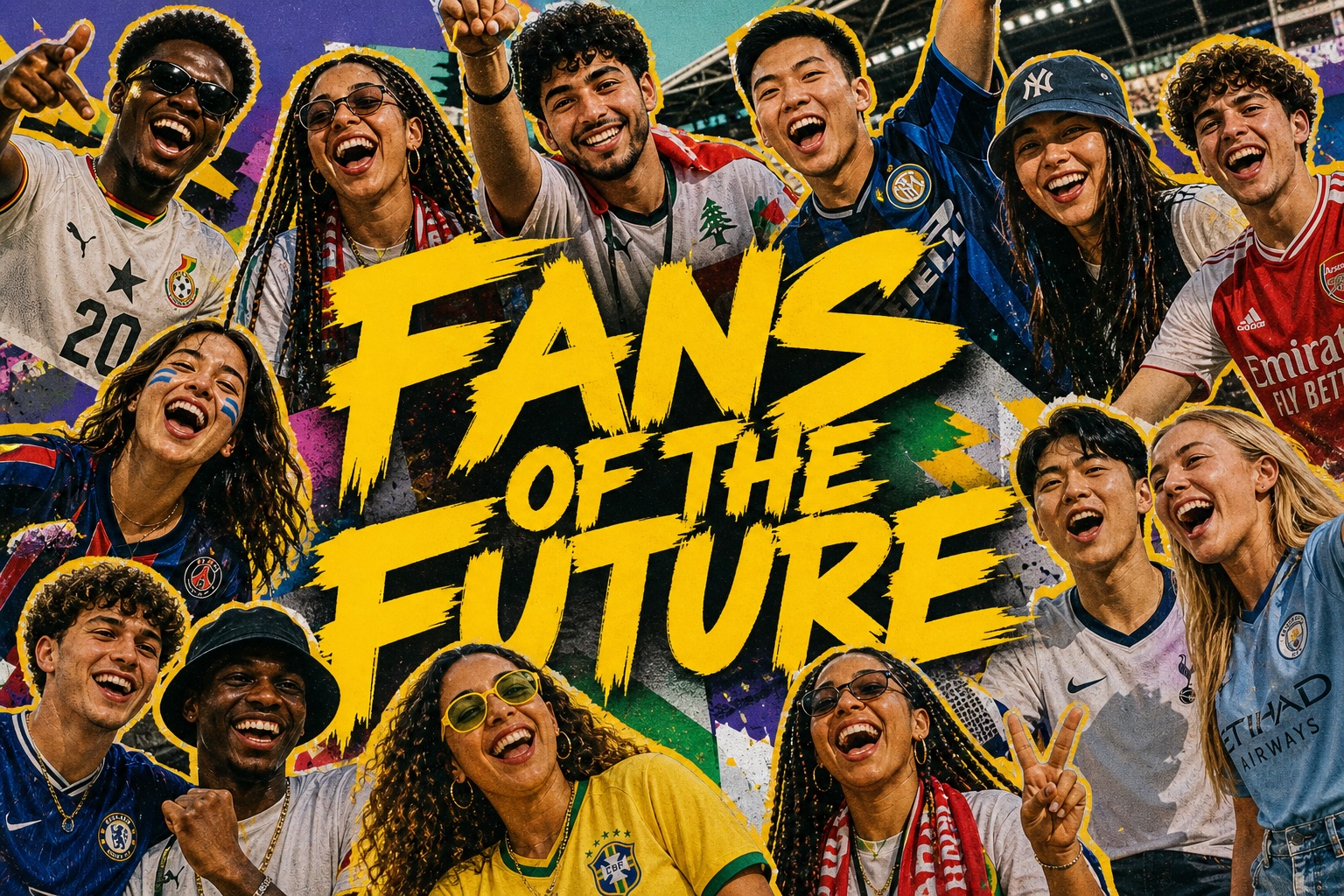
Fandom is the most powerful force in culture. The question is no longer how to build for fans, it's what to build. Fantenna helps brands tap in, nurture it, create it, and convert it into first‑party relationships. Backed by a decade of methodology, five specialist agents, behaviour from 300 million fans per year, and the Future Fan Panel, real people in the cities where culture emerges.
Each agent has a specific job, a specific voice, and a strong opinion. They debate every recommendation with named axes of disagreement, so you read what survived, what was killed, and what was reshaped, not a summary that hides the working.


Behind every Fantenna recommendation is a panel of real fans, recruited, paid and looked after directly, in the markets where fandom is shifting fastest. The agents read panel responses alongside your first-party data, so what you build is grounded in actual human language, not just signals. The panel is scaling: London is live, expanded coverage across UK, North America, France, Germany and the rest of Europe is rolling through 2026.
Most of my mates are at the stadium and I'm watching at home. The app should know that and find me other people watching alone.
Out here you only see the highlights and the kit drops. Show me the boring stuff. The team talk, the bench, the moments other fans actually argue about.
I run fantasy teams in three different leagues at the same time. Your app makes me check them one by one. I want all my players, all my points, in one screen.
Engaging fans should not mean guesswork.
Fantenna doesn't stop at recommendations. The commission flows from your brief through the agent debate to a deliverable creative-and-technology plan, ready to ship. Strategy, format design, surface choice, sponsor pack and the technical spec arrive together, not in three separate procurement cycles.
Decoded brief, agent debate, fan-funnel projection. Defensible to your board.
Recommendations come with the artefacts you ship. Web, mobile, CTV, SDK, sponsor pack, named destination.
Build, hosted and shipped on our delivery platform: a fan engagement infrastructure that powers more than 240 live formats and processes hundreds of millions of fan interactions a year.
When AI templates are not enough, send the brief to a vetted creator on the Fantenna roster. Real humans, real voices, on-brand. Recruited and managed for cultural fit in their market, not generic influencer pools. Across the cohort: tactics writers, highlights editors, long-form video, match-day reactives, and culture-led storytellers.


Fans live across web, app, messaging, social, the second screen, the venue and the operating system itself. Fantenna closes the loop on every one: listening for signal, shipping the right format, reading the response. Built phone-first for the audiences raised on phones, scaled to reach every generation that watches sport.
A format is one engagement primitive: a survey, a vote, a predict-and-react, a drop. Fantenna ships a format to a surface for a moment. Every shipped format teaches the agents what works for which fans, where.
Live, in-the-moment prediction games tied to a beat in the broadcast. Highest dwell-time format we run.
Fan voting on outcomes, line-ups, MVPs and brackets. Moves the needle on identity and status.
Question-of-the-day to a Future Fan Panel cohort. Answers feed back into the morning brief.
Shareable fan profile cards: what kind of fan you are, who you'd recommend. Built for social.
Second-screen experience that tracks the live event, with stats, votes and prompts for the moment.
Time-bound digital drops: collectibles, reveals, unlockables, gated by participation or location.
Fantenna sits on top of a fan engagement infrastructure that has been live for more than ten years. The agents are tuned on telemetry from hundreds of millions of live-format sessions, hundreds of named customer deployments, and a moving fan-voice corpus from real cohorts. The training data is the moat; the agents are the interface.
Customers include the world's top-flight rights holders, broadcasters and fan-led brands. Premier League. Bundesliga. NBA. Real Madrid. FIFA+. Formula E. WSL. Sky Sports. Peacock. EA SPORTS. SuperSport. Stats Perform. Fanatics. The construct library and case-study library inside Fantenna are anchored against named, deployed customer work, not theoretical patterns.
Every shipped format feeds telemetry back into the agents, sharpening the next recommendation. Iteration is the design target, not the exception. v2, v3, v4 of every format is the standard. Decks on a shelf are the alternative.
At Enterprise tier, Fantenna learns from what you already know. Your CRM. Your past campaigns. Your apps and sites. Your tone of voice. Your sponsor deals. The agents stop guessing and start citing your reality. The output is something you can actually ship.
"Your prior bracket campaign converted at 22% on iOS but only 9% on web. Same audience, same format. The drop is the third-step opt-in. Run iOS-first, web as the share surface."
[Source: customer-context, file: priors/bracket-q4.md]
"Your Brazilian cohort is asking the same questions your German cohort was asking eighteen months ago. The local-language commentary feature you shipped in DE in 2024 maps directly. Six-week window before competitors notice."
[Source: customer-context, file: cohorts/by-market.md]
"60% of this lands in your existing stack: your iOS app handles the vote flow, your CRM owns the cohort, your Tuesday email cadence already runs. Net new build is the second-screen variant for CTV. 9 days end-to-end."
[Source: customer-context, file: stack/inventory.md]
Fantenna gets adopted across departments because budgets pool naturally around fan engagement. Here is how each role uses it.
Fantenna runs against a canonical knowledge corpus by default. The unlock is loading your in-house context: brand guidelines, prior campaigns, surface telemetry, CRM cohorts, broadcast deal terms. Pro and Enterprise tiers turn directional output into operationally accurate output. Discounted access available for qualifying charities, public-interest research and educational institutions.
A real Fantenna run, with no in-house context. Directional output, valuable as a sample of what the product does. Issued to qualified rights holders, broadcasters and brands, not self-service.
The unlock. Your in-house context loaded as a layered knowledge bundle. The agents cite your prior campaigns, your CRM cohorts, your surface telemetry. Output stops being directional and becomes operational.
--compare-with: run, refine, re-run, see what changedOperationally embedded across your organisation. One contract, unlimited internal logins, pooled budget, shared scenario library. Your own panel cell, your SDK in your apps, your named destination. Fantenna becomes the closed loop between your fan signal and your next deployment.
Pro tier ingests your context once at onboarding. Enterprise refreshes quarterly + integrates real-time. The technical pipeline (`fantenna run --tier pro --customer-context-dir <path>`) is the same; the services layer + commitment cadence is what changes.
No. The agents are tuned on a decade of fan engagement work, telemetry from millions of live-format sessions, panel waves, and hundreds of shipped briefs. The model is the cheap part. The training data and the construct library are the moat.
Three architectural commitments. First, a grading dial sets the latitude per run: STRICT mode constrains agents to canonical constructs and case studies only; REFERENCED mode allows novel proposals provided each carries an external citation; ARTISTIC LICENSE mode permits exploratory ideas with internal justification (used for early concept work, never for shippable plans). Second, the five-specialist debate forces named axes of disagreement and at least one killed or reshaped hypothesis per run. Third, the self-critique stage audits phantom-math and agreement-too-easily before the run closes.
No. Briefs are portable. Send them to our delivery platform, your in-house team, your roster of creators, or post them externally. We charge for the agents and the strategy layer, not the build. Most customers use the delivery platform for the heavy infrastructure and creators for the on-brand content layer.
You bring the sources, you own the data. Fantenna processes fan voices in your tenant, never trains on it, and gives you a one-click export of every quote, decision, and brief. Contract-end deletion is built in.
The Free Trial runs the same day, against the canonical corpus. Pro tier customer-context ingestion takes weeks (not months). Enterprise customer-success engagements typically deliver the first operationally-accurate run within a quarter.
Yes. The Enterprise tier is built for cross-departmental adoption. One organisation contract, unlimited internal logins, pooled budget, shared scenario library across departments. Per-run privacy flags let teams keep work private to a department or share organisation-wide. The more teams that use it, the more the data compounds.